
Last Updated on 4 weeks by admin
South Korea faces a structural $10B tourism deficit in 2026. Beyond the 20.36M arrivals, discover how ‘App-Silo’ barriers and a ₩14T liquidity surge abroad are challenging the ₩7.85T budget’s regional revitalization goals.
The Era of 20 Million
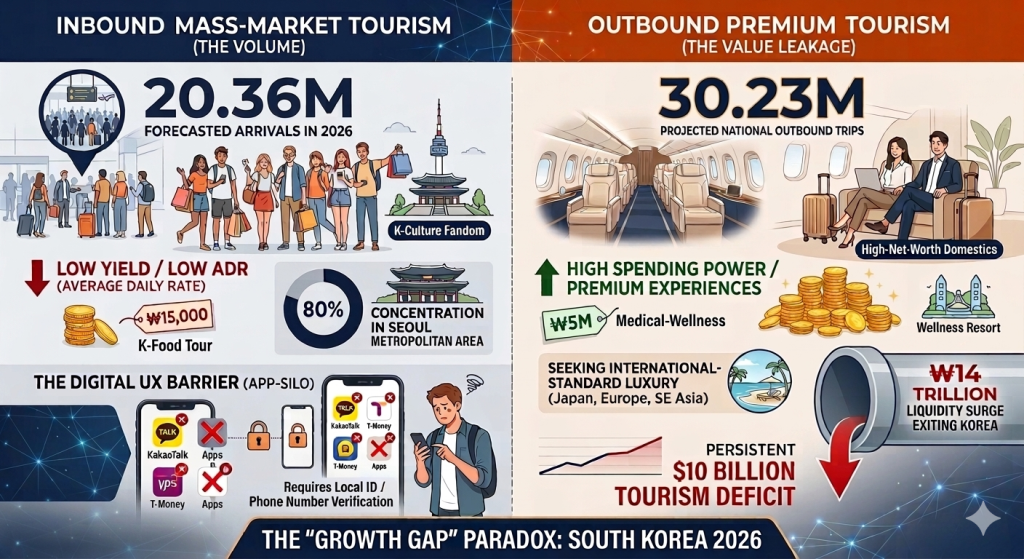
According to the latest projections from Yanolja Research, inbound foreign arrivals are forecasted to hit a historic peak of 20.36 million in 2026, marking an 8.7% YoY increase. While the Ministry of Culture, Sports and Tourism (MCST) celebrates this volume milestone with a record ₩7.85 trillion budget ($5.35B), the fiscal reality is far less celebratory. Total outbound trips by Korean nationals are expected to reach 30.23 million, creating a persistent $10 billion (approx. ₩14 trillion) tourism deficit. This “Quantity vs. Quality” paradox reveals a structural asymmetry where the value leaked by outbound spending continues to dwarf the liquidity captured from inbound segments.
Structural Asymmetry & The “Value Trap”
For over a decade, the success of South Korean tourism has been measured by the arrivals at Incheon International Airport. However, as we approach the 20M visitor threshold, the structural imbalance between inbound yield and outbound leakage has reached a breaking point. While inbound volume is growing at 8.7%, outbound travel is projected at 30.23 million trips. That’s nearly 10 million more than the inbound flow. This isn’t just a numerical gap; it is a massive liquidity surge exiting the Korean economy.
For international investors and hospitality founders, this asymmetry suggests that the Korean market is currently bifurcated. On one side, you have the “Mass-Market Inbound.” It is largely driven by regional K-Culture fandom. It generates high volume but low Average Daily Rate (ADR) due to a heavy concentration in budget-friendly Seoul districts. On the other side, the high-net-worth Korean domestic segment is aggressively opting for premium experiences outside Korea. They are preferring Japan, Europe, and Southeast Asia, and taking their high-spending power with them.
Why It Matters
Korea is failing to capture the “Premium” segment of its own population while simultaneously over-investing in low-yield volume. This creates a value trap where infrastructure is built to support millions of budget travelers. The real profit centers—international-standard luxury and high-engagement experience commerce—are underserved domestically. A flight to quality is mandatory. If the industry continues to prioritize ₩15,000 “K-Food” tours over ₩5M “Medical-Wellness” clusters, the $10 billion deficit will not just persist; it will become a permanent structural drag on the GDP.
Global operators should be looking at the Experience Economy as the only viable bridge. The ₩1.48 trillion tourism budget allocated by the MCST is a signal that the government is finally recognizing this leakage. The impact of the 2026 budget isn’t just in the total amount, but in the shift toward “High-Value Inbound.” It specifically targets the K-Culture training and high-end medical sectors. Investors should prioritize assets that can internalize the spending currently leaking abroad. Investing in projects such as high-spec “Smart Tourism” hotels in Busan or Jeju that can compete with international premium standard.
The Seoul Concentration & The “App-Silo” UX Barrier
What Korea “gets wrong” about its own ecosystem is the belief that promotion alone solves the deficit. Currently, nearly 80% of foreign tourists never leave the Seoul metropolitan area. This Seoul Concentration creates a localized saturation point where infrastructure (transport, heritage site capacity) is strained to the limit. On the other hand, regional hubs like Gangwon and Jeolla face a “Tourism Desert” status. The ₩6.5 billion “hometown vacation support” pilot is a move in the right direction. It refunds 50% of travel expenses for regional visits—a good move, but just a “Band-Aid” on a bigger problem.
The real friction is the lack of “Regional Connectivity” from the moment of entry. While the government pushes for Gimhae and Muan airport expansions, the actual passenger UX remains a nightmare for non-Korean speakers. This is the “App-Silo” problem: highly efficient Korean transport and payment apps (KakaoTalk, T-Money, various regional passes) often require local ID verification or domestic phone numbers. It creates an invisible wall for the high-yield international segment.
Furthermore, the regulatory “grey zones” surrounding the new visa tiers—specifically the F-1-D Digital Nomad visa—add another layer of friction. While the 2026 extension is a win, the ₩84.96M ($66,000) income threshold still acts as a filter. And the current digital infrastructure isn’t ready to handle it. A “Premium Nomad” expects seamless O2O (Offline-to-Online) conversion. Whether it is a global credit card acceptance, and high-speed regional rail integration that doesn’t involve wrestling with a Korean-only UI.
The government must solve the logistics bottleneck. Moving travelers beyond Gyeongbokgung Palace is mandatory. At present, the 80% Seoul concentration acts as a growth ceiling. High-value travelers do not want to “struggle” to spend money in regional Korea. They seek the frictionless luxury they find in Tokyo or Singapore. The current execution of “Digital Humanity” in hospitality is often just “More Screens and More Apps,” rather than a cohesive, global-standard UX.
The Strategic Outlook: A Pivot to “Irreplaceable Value”
The prediction is clear: Volume has peaked, and the bypass starts now. By Q3 2026, we expect to see the $10 billion deficit spark a series of aggressive policy pivots. The government cannot sustain a 14 trillion won leak indefinitely. Consequently, we anticipate a liquidity squeeze on low-end tour operators and a massive regulatory push toward the “E-7-M (K-Core)” visa and other talent-integration models.
The “Balloon Effect” of Chinese-Japan geopolitical tension will likely push arrivals even higher—potentially toward 21.26 million in an optimistic scenario. But, this volume will only worsen the deficit if it remains “Short-Haul Budget.” The winners of 2026 will be those who stop counting heads and start counting “Retention value.”
Related Posts
354 total views, 12 views today