Thursday, January 22, 2026
  • Login
KoreaTravelPost - South Korea's Leading Travel Media Publication
  • Home
  • Travel Industry News
  • TRAVEL
    • Accomodation
    • Activities
    • Attractions
    • Day Tours
    • Food & Drink
    • K-Entertainment Tours
    • Korean Culture
    • Must Buy
    • Shopping Destinations
    • Transportation
    • Travel Essentials
    • Travel Tips
    • Travel News in Korea
  • Cities
    • Busan
    • Daegu
    • Daejeon
    • Gwangju
    • Incheon
    • Jeju
    • Seoul
    • Ulsan
  • Regions
    • Gangwon-do
    • Gyeonggi-do
    • North Gyeongsang (Gyeongsangbuk-do)
    • North Jeolla (Jeollabuk-do)
    • South Chungcheong (Chungcheongnam-do)
    • South Gyeongsang (Gyeongsangnam-do)
    • South Jeolla (Jeollanam-do)
  • About us
No Result
View All Result
KoreaTravelPost - South Korea's Leading Travel Media Publication
  • Home
  • About Us
No Result
View All Result
No Result
View All Result

South Korea Is Ending Its Beauty & Medical Tax Refund in 2026 — And It Signals a Shift in Medical Tourism Strategy

KoreaTravelPost Editor by KoreaTravelPost Editor
January 21, 2026
in Travel News in Korea
0 0
0
Home Travel News in Korea

South Korea ends its beauty and medical tax refund in 2026. Here’s why the policy is changing and how it impacts medical tourism and travelers.

For nearly a decade, South Korea’s beauty and medical tax refund program has played a quiet but influential role in positioning the country as a global hub for medical tourism. Beginning in 2016, the policy allowed short-term foreign visitors to reclaim 6–8% of VAT on eligible cosmetic and medical procedures — a financial incentive layered on top of Korea’s already competitive pricing and clinical expertise.

That incentive disappeared on January 1, 2026.

While the change may seem minor at first glance, it reflects a broader recalibration of how South Korea approaches medical tourism — and it carries real implications for travelers, clinics, and booking platforms alike.

Table of Contents

Toggle
  • What Exactly Is Ending — and What Isn’t
  • Why This Policy Change Matters
    • Cost Comparison Data
    • Key Policy Changes
  • How the Market Is Adapting
  • What Travelers Should Do Now
  • The Bigger Picture
    • Related Posts

What Exactly Is Ending — and What Isn’t

The government-backed tax refund applied specifically to medical and aesthetic services, including dermatology treatments, cosmetic surgery, and certain dental procedures. These services are subject to Korea’s standard 10% value-added tax, which will remain in place even after the refund program ends.

Importantly, this policy change does not affect:

  • Retail tax refunds for shopping purchases
  • Duty-free shopping at airports and certified stores

In other words, the rollback is surgical, targeting medical tourism rather than tourism spending as a whole.

✓ 2016 — Refund Introduced To stimulate inbound medical tourism.
↑ 2018–2019 — Growth Phase Increasing foreign patients and global attention.
! 2020–2021 — COVID-19 Disruption Global travel restrictions pause medical tourism.
✕ Dec 31, 2025 — Final Eligibility The final day to claim medical VAT refunds.
■ Jan 1, 2026 — Policy Termination Official end of the medical beauty tax refund program.

Why This Policy Change Matters

The original refund program was introduced to stimulate inbound medical tourism, lowering the effective cost of high-ticket procedures and encouraging longer stays. Ending it suggests that Korea no longer sees tax refunds as essential to attracting foreign patients — a signal of confidence in demand, brand strength, or both.

For travelers, the immediate impact is financial: procedures performed after December 31, 2025 will carry the full VAT cost with no post-treatment reimbursement. On high-value treatments, that difference is meaningful, not cosmetic.

For the industry, however, the change forces a transition:

  • Clinics can no longer rely on government incentives to close price-sensitive customers
  • Platforms and intermediaries are stepping in with private cashback and discount mechanisms
  • Competition shifts from tax efficiency to bundled value, transparency, and experience
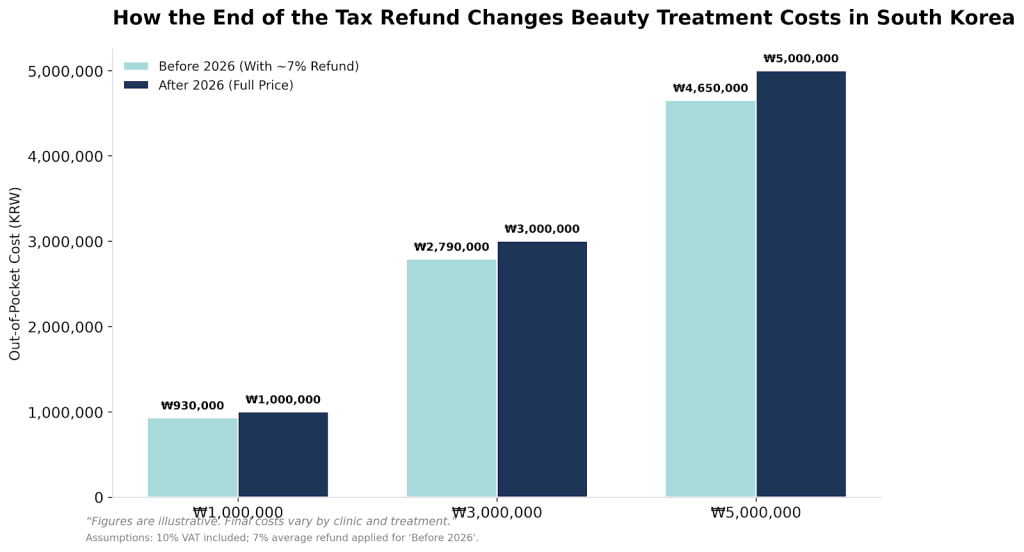
Cost comparison of beauty treatments in South Korea before and after the 2026 tax refund end
Comparison of treatment costs with VAT refunds before 2026 and full VAT costs after the refund ends.

Cost Comparison Data

Treatment Sticker PriceBefore 2026 (Out-of-pocket)*After 2026 (Out-of-pocket)Difference
₩1,000,000₩930,000₩1,000,000+₩70,000
₩3,000,000₩2,790,000₩3,000,000+₩210,000
₩5,000,000₩4,650,000₩5,000,000+₩350,000
*Calculated based on a 7% average effective refund (within the typical 6–8% range).

Key Policy Changes

  • Standard VAT: A 10% Value Added Tax is currently included in the price of most medical beauty treatments (e.g., fillers, laser treatments, plastic surgery).
  • The Refund Mechanism: Until the end of 2025, international travelers can claim back a portion of this VAT (usually 6–8% after service fees) at airports or city kiosks.
  • Post-2026 Outlook: Starting January 1, 2026, this tax incentive is slated to expire. International patients will be required to pay the full sticker price inclusive of VAT, effectively increasing out-of-pocket costs by the amount previously refunded.

How the Market Is Adapting

Rather than reducing prices outright, many clinics and booking platforms are experimenting with cashback models, loyalty credits, and bundled service offerings to offset the loss of the tax refund.

This marks a structural change: savings are no longer standardized by policy, but fragmented across platforms and partnerships. For travelers, that means more choice — but also more responsibility to compare total costs and conditions.

The refund era offered simplicity. The post-2026 landscape will reward planning.

What Travelers Should Do Now

  • Travelers considering major procedures may want to schedule treatments before the end of 2025 to take advantage of the remaining refund window.
  • For trips in 2026 and beyond, the focus should shift to total cost transparency, not advertised base prices.
  • Understanding whether a clinic participates in private cashback or credit programs will become increasingly important.

The Bigger Picture

South Korea remains one of the world’s most advanced destinations for cosmetic and dermatological care. Ending the tax refund does not weaken that position — but it does mark the end of a policy era where government incentives underpinned medical tourism growth.

What replaces it is a more market-driven ecosystem, where platforms, clinics, and consumers negotiate value directly.

For travelers, the takeaway is simple: Korea is still a top-tier beauty destination — but from 2026 onward, smart planning matters more than ever.

From picturesque landscapes to hidden gems and cultural adventures, follow KoreaTravelPost’s Twitter, Facebook, Instagram, LinkedIn, and Flipboard for a thrilling journey through the heart of Korea.

Related Posts

Why Korea Has Become a Global Hub for Medical and Beauty Tourism Medical Tourism in Korea 2025: $1 Billion Industry at a Crossroads Laser Eye Surgery in Korea: The Ultimate Guide for International Patients

 60 total views,  41 views today

What’s your thoughts?
+1
0
+1
0
+1
0
+1
0
+1
0
+1
0
+1
0
Facebook Twitter Email
Tags: Medical Tourismmedical tourism KoreaSkin Clinicstravel policyTravel Policy Updates
ShareTweetShareSendSend
KoreaTravelPost Editor

KoreaTravelPost Editor

Hello there! I'm the Features Editor for KoreaTravelPost.

Related Posts

AI beauty duty-free experience
Travel News in Korea

Hyundai Duty Free’s AI Beauty Experience Signals a Strategic Pivot in Global Travel Retail

January 20, 2026
Korean traditional goods
Must Buy

How K-Pop Culture Is Fueling a Global Revival of Korean Traditional Goods

January 15, 2026
Korea tourism trends forecast 2026 dualism
Travel News in Korea

Korea Tourism Trends 2026: Why “Dualism” Is the Keyword Defining the Future of Travel

December 26, 2025
Seoul top 10 travel city
Travel News in Korea

Why Seoul’s Global Appeal Is Growing Among International Travelers

December 24, 2025
foreign tourists Korea public transport credit card transit
Travel News in Korea

Traveling in Korea May Soon Get Easier for Foreign Tourists

December 22, 2025
Chinese tourists in South Korea
Travel News in Korea

South Korea Sees Sharp Rise in Chinese Inbound Tourism This Winter

December 21, 2025
No Result
View All Result

More from our network


  • ktd

  • atd

  • itd

  • ktt

  • kgd

  • kpp

  • ktp

  • kpoppost

  • ustechtimes

Categories

  • Accomodation
  • Activities
  • Attractions
  • Day Tours
  • Events
  • Food & Drink
  • Interview
  • K-Entertainment Tours
  • Korean Culture
  • Medical Tourism
  • Must Buy
  • Shopping Destinations
  • Transportation
  • TRAVEL
  • Travel Essentials
  • Travel Industry News
  • Travel News in Korea
  • Travel Tips

FREE NEWSLETTER

Follow Us

  • instagram
  • twitter

Copyright © 2024 About Us| Terms of Use |Privacy Policy|Cookie Policy| Contact : [email protected]

Welcome Back!

Login to your account below

Forgotten Password?

Retrieve your password

Please enter your username or email address to reset your password.

Log In
No Result
View All Result
  • Home
  • Travel Industry News
  • TRAVEL
    • Accomodation
    • Activities
    • Attractions
    • Day Tours
    • Food & Drink
    • K-Entertainment Tours
    • Korean Culture
    • Must Buy
    • Shopping Destinations
    • Transportation
    • Travel Essentials
    • Travel Tips
    • Travel News in Korea
  • Cities
    • Busan
    • Daegu
    • Daejeon
    • Gwangju
    • Incheon
    • Jeju
    • Seoul
    • Ulsan
  • Regions
    • Gangwon-do
    • Gyeonggi-do
    • North Gyeongsang (Gyeongsangbuk-do)
    • North Jeolla (Jeollabuk-do)
    • South Chungcheong (Chungcheongnam-do)
    • South Gyeongsang (Gyeongsangnam-do)
    • South Jeolla (Jeollanam-do)
  • About us

Copyright © 2024 About Us| Terms of Use |Privacy Policy|Cookie Policy| Contact : [email protected]