
Last Updated on 6 months by admin
Analysis of the 2026 South Korean K-culture training visa, exploring the economic impact of institutionalized fandom and regulatory friction.
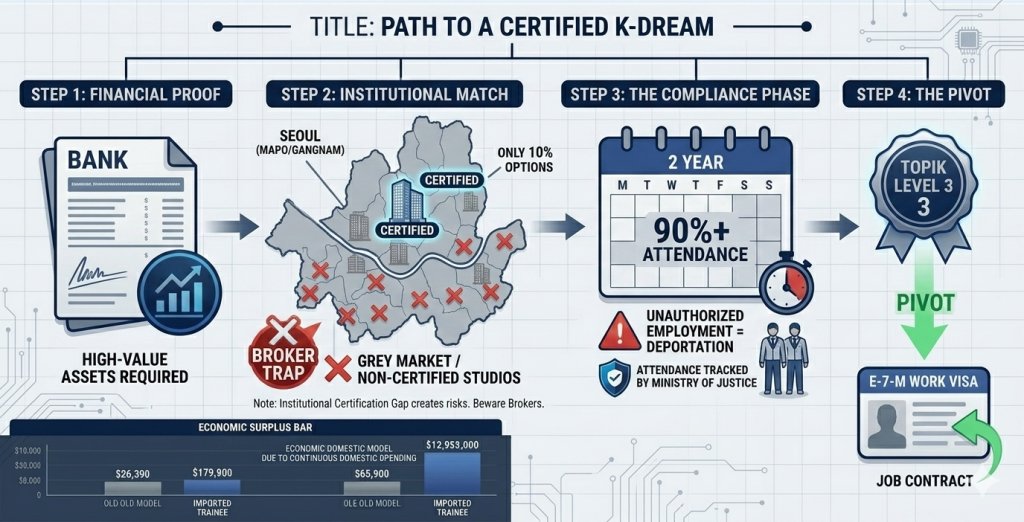
The 2026 official permanent launch of the K-culture training visa marks a strategic pivot for South Korea. Previously a trial initiative, the program now functions as a regulated institutional framework designed to convert global fandom into measurable economic data. The Ministry of Culture, Sports and Tourism (MCST) now mandates that participants enroll in “Officially Certified” institutions. This move stabilizes the Hallyu economy by replacing informal training models with a standardized educational system. Current policy allows for a two-year residency, with extensions available upon institutional recommendation.
However, the 2026 update strictly prohibits employment under this specific visa category. Its primary purpose remains educational, preserving the integrity of the E-6 entertainer visa while providing a legitimate path for the global “trainee” demographic. This transition from fan service to institutional rigor addresses the structural need for long-term stay management beyond the traditional travel window. It represents a fundamental shift in how Korea views its cultural exports—no longer just as media products, but as an immersive infrastructure for human capital development. This maturity in policy reflects a broader national strategy to diversify tourism beyond sightseeing into high-engagement experiential residency.
The Economic Integration of Hallyu Education
The fiscal impact of the K-culture visa in 2026 extends far beyond ticket sales and merchandise. By institutionalizing the training process, South Korea is capturing a high-value demographic of long-stay residents who contribute significantly to the local service economy. The content industry exports reached a historic $14.08 billion in 2024, with the music segment alone accounting for $1.8 billion. However, the traditional export model relied on digital consumption and overseas touring. The 2026 visa strategy flips this script by importing the consumer into the domestic production ecosystem.
This “Imported Training” model represents a structural shift in how soft power is monetized. Instead of relying on volatile global trends, the government is building a permanent infrastructure for cultural education. We are seeing the rise of the “Mega-Academy”—private institutions that function with the administrative rigor of universities but the specialized curriculum of K-pop agencies. These academies are no longer just dance studios; they are comprehensive hospitality and education hubs. They provide a standardized environment for international talent, effectively de-risking the “K-dream” for foreign parents and investors.
Crucially, the K-culture visa acts as a liquidity bridge for these institutions. By providing a stable, multi-year pipeline of international students, academies can invest in high-end facilities and faculty. This creates a secondary market for specialized services, including content creation studios, styling consultants, and intensive language programs tailored for performers. Consequently, the “Hallyu Economy” is graduating from a series of pop-up events into a permanent industrial sector. The 2035 forecast for the K-pop events market, estimated at $17.44 billion, is predicated on this very ability to sustain long-term engagement on Korean soil. This economic engine is now robust enough to influence local real estate and urban planning in training hotspots.
The Institutional Friction and the “Broker Trap”
Despite the ambitious economic goals, the implementation of the K-culture visa is fraught with structural friction that often surprises global applicants. The primary hurdle is the “Institutional Certification” gap. While thousands of dance studios operate in Seoul, only a fraction meet the Ministry of Justice’s stringent criteria for visa sponsorship. This lack of clear documentation creates a breeding ground for illegal brokers. These intermediaries often promise visa guarantees for non-certified studios, leading to “visa traps” where applicants enter on tourist visas only to have their long-term training applications denied.
Furthermore, the government is signaling a zero-tolerance policy for administrative mismanagement. In 2025, the Ministry of Education banned 20 universities from issuing student visas due to high rates of illegal stays and poor student management. This crackdown is now filtering down to the K-culture academy sector. Institutions that fail to track attendance or permit students to engage in unauthorized employment face immediate suspension of their “Certified” status.
This regulatory environment creates a bifurcated market. On one side, premium academies with government backing offer high-security, high-cost programs. On the other hand, the “Grey Market” of smaller studios remains inaccessible to international students seeking legal residency. Paradoxically, the very rigor intended to protect students often acts as a UX barrier. The financial requirement—often necessitating proof of significant assets—excludes a segment of the global talent pool that the Hallyu wave initially attracted. This structural imbalance suggests that the visa is currently optimized for “High-Value” cultural tourists rather than the egalitarian “dreamers” often depicted in K-pop marketing.
Strategic Outlook: The Consolidation of the Training Sector
The next 24 months will likely see a significant consolidation of the Korean cultural education market. The “Gold Standard” certification program, slated for a 2027 full-scale rollout, will formalize the requirements for academy-led visas. This will effectively eliminate smaller, undercapitalized players who cannot meet the administrative burden of foreign student management. For investors, this signals an interest in established educational infrastructure and specialized student housing in training hubs like Gangnam and Mapo.
Crucially, the 2026 update introduces the E-7-M (K-CORE) work visa as a potential graduation path. While the K-culture visa itself prohibits labor, students who achieve Topik Level 3 proficiency and complete recognized vocational programs can now pivot to this new employment category. This structural linkage transforms the training visa from a temporary residency into a talent pipeline for the domestic economy. It addresses the “Value Trap” of cultural tourism by offering a clear pathway to professional integration. This mechanism effectively converts the $14 billion content industry into a sustainable labor recruitment strategy for Korea’s aging economy.
Nevertheless, the risk of over-regulation remains. If the visa requirements continue to tighten in response to immigration concerns, the “friction” may outweigh the “fame.” The government must balance the need for security with the agility required to capture fast-moving cultural trends. For now, the K-culture visa remains a powerful, if rigid, tool that transforms the ephemeral nature of fandom into a stable pillar of the Korean tourism economy. We anticipate that by 2030, this model will be the primary driver of inbound tourism revenue, surpassing traditional retail and heritage visitation in terms of per-capita spend.
Related Posts
986 total views, 1 views today