
Last Updated on 6 months by admin
Imagine landing at Incheon Airport and having your smartphone instantly become your medical ID, your wallet, and your key to tax-free shopping. For the modern traveler, the friction of international healthcare often starts long before the surgery. It begins with the anxiety of carrying a physical passport to every consultation, the frustration of declining credit cards at local pharmacies, and the confusion of language barriers during critical medical discussions. This is no longer the reality in South Korea. On March 10, 2026, fintech leader Roadsystem and the Korea Medical Tourism Promotion Association (KMPA) signed a landmark strategic alliance. This partnership marks a definitive shift toward a technology-integrated medical ecosystem designed to make the patient journey as smooth as a domestic digital transaction.
The Structural Shift: Moving from Brokers to Digital Platforms
For years, the South Korean medical tourism market was defined by a fragmented “broker” system. These third-party agents often acted as the primary link between hospitals and foreign patients. While they provided a service, the model was plagued by a lack of price transparency and high hidden commissions.
“We will build a new digital tourism infrastructure model that connects medical services with tourism consumption.”
CEO Yang-ho Jang (장양호), Roadsystem
The collaboration between Roadsystem and KMPA addresses these pain points by utilizing the TripPASS platform. This platform is not just a payment app; it is a regulatory-compliant identity solution. International visitors can now verify their identity via smartphone using patented mobile-passport eKYC (electronic Know Your Customer) technology.
By using the phone as a secure digital passport, the platform removes the need for patients to carry physical documents to clinics. This digitization is the foundation of “Karecation”—a growing model that blends high-end medical care with leisure tourism. By moving the “trust” from a human broker to a digital rail, KMPA is ensuring that the patient’s first point of contact with the Korean medical system is secure, transparent, and efficient.
The Infrastructure: K-Medicon and the Power of 1,000 Specialists
At the heart of this transformation is the K-Medicon Card. This prepaid solution handles medical expenses, retail shopping, and public transportation on the TripPASS rail. However, its value extends beyond simple payments.
In Korea, many tourists find that their home-country credit cards are either not accepted at small local pharmacies or incur heavy foreign transaction fees. The K-Medicon card solves this by operating on local payment rails, providing the same convenience as a local resident’s card. Furthermore, the system includes a standout feature: the immediate mobile tax refund. Foreign patients can receive VAT refunds instantly at pharmacies through their phones, bypassing the long queues at airport refund counters.
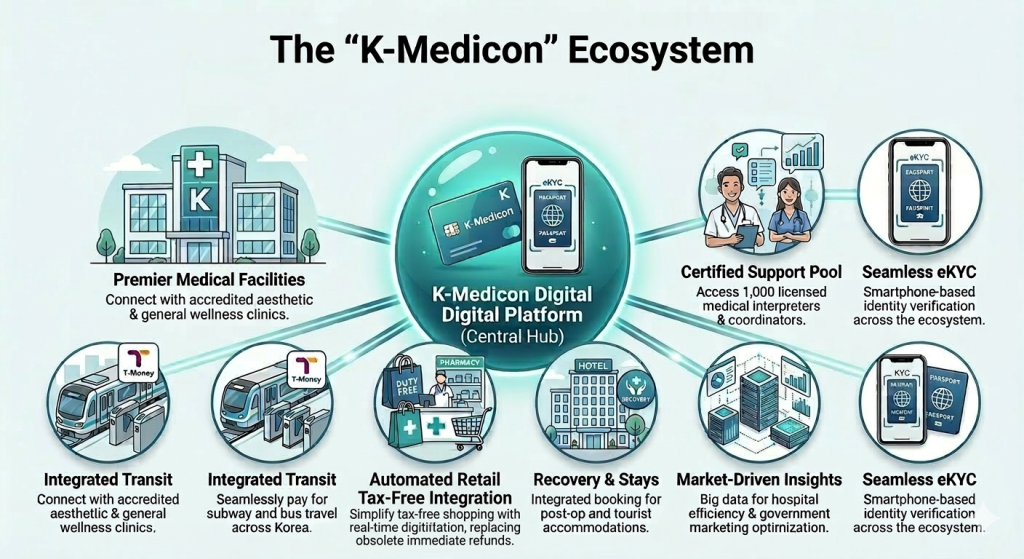
Technology, however, is only half of the solution. Medical procedures require a high degree of human trust and clear communication. To support the digital push, the Seoul Metropolitan Government and KMPA are scaling the pool of medical interpreter-coordinators tenfold. They aim to have 1,000 certified professionals active by the end of 2026. These specialists are not just translators; they are trained medical guides. They ensure that from the moment a patient uses the K-Medicon app to book a consultation, they have a professional by their side to explain complex surgical terms and recovery protocols.
Economic Indicators: The $2.5 Billion Surge
The urgency of this digital shift is clear when looking at the explosive growth of the last 24 months. South Korea has transitioned from a specialized surgical hub to a global daily wellness powerhouse.
- 2025 Revenue Milestone: International patient spending in South Korea reached a historic ₩3.66 trillion (approx. $2.47 billion) in 2025. This represents a 65.3% surge from the ₩1.25 trillion ($1 billion) recorded in 2024.
- The Rise of Wellness: While complex surgeries remain a staple, dermatology and aesthetic treatments now drive 57.4% of total medical spending. This “high-frequency, low-friction” market is exactly what the K-Medicon card is designed to serve.
- Operational Efficiency: Clinics using the eKYC and K-Medicon system report a 40% reduction in administrative check-in times. This efficiency is vital as the country aims for 700,000 foreign patients annually by 2027.
Addressing the Real-World Hurdles
Despite the high-tech promise, the Roadsystem and KMPA alliance is working through significant real-world challenges. The integration of medical data with financial apps requires strict compliance with South Korea’s Personal Information Protection Act (PIPA). This is why the eKYC component is so critical; it provides a government-standard security layer that protects sensitive patient information.
Additionally, there is the challenge of “last-mile” adoption. For the system to be truly effective, it must be accepted not just in major hospitals in Gangnam, but in every small clinic and pharmacy across the country. KMPA’s roadmap for 2026 includes intensive training for medical staff on how to use the K-Medicon backend to process payments and verify identities instantly.
The User Journey: A Day in the Life of a K-Medical Tourist
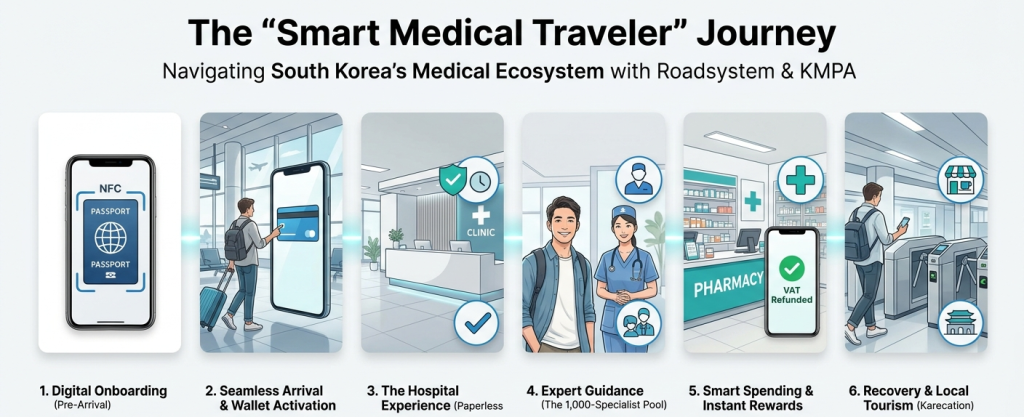
To understand the impact of this alliance, consider the new typical journey:
- Preparation: Before leaving home, the patient downloads the TripPASS app and verifies their identity using their passport NFC chip.
- Arrival: Upon landing, they load their K-Medicon wallet. Their phone is now a valid ID for hospital check-ins.
- Do Not Plan for a Medical Refund: When budgeting for procedures like laser treatment, Botox, fillers, or plastic surgery, ensure you are planning for the final price, inclusive of the non-refundable 10% VAT
- Treatment: At the clinic, they “tap” their phone to pay. The 1,000-strong interpreter pool ensures a coordinator is already there, briefed on their case via the app’s secure portal.
- Recovery: After the procedure, the patient visits a nearby pharmacy. The VAT for medical products purchased in pharmacies is automatically deducted from the price and credited back to their wallet.
- Tourism: They use the same wallet to pay for a subway ride to Gyeongbokgung Palace or a meal in Myeongdong.

Looking Ahead: The Future of Global Health Mobility
The Roadsystem-KMPA alliance offers a blueprint for global medical hubs like Bangkok, Dubai, and Singapore. By solving the dual challenges of identity and finance, Korea has created a “trust layer” for both patients and providers.
Hospitals gain guaranteed payments and reduced paperwork. Patients enjoy the security of a government-backed framework. As the system evolves, expect to see the K-Medicon card integrate with insurance providers, allowing for direct-billing of international policies. This evolution ensures the focus remains exactly where it should be: on the quality of care and the path to recovery. South Korea is no longer just selling medical procedures; it is selling a frictionless, secure, and world-class healthcare experience.
Related Posts
958 total views, 1 views today