

Last Updated on 4 months by admin
Ravi, founder of Konnect, shares why he built a platform to help tourists, students, and expats navigate life in South Korea more easily.
Moving to or traveling in a new country is exciting—until everyday tasks become unexpectedly complicated. From navigating transportation apps to finding reliable information in a foreign language, even simple activities can feel overwhelming. This is a reality many foreigners experience in South Korea, despite its world-class infrastructure and technology.
To address these gaps, Ravi S. Pandit, founder of Konnect, is building what he calls “the only app you need in Korea.” Designed by a foreigner, for foreigners, Konnect aims to simplify life in Korea—whether you’re visiting for a week, studying for a semester, or settling long-term.
The platform’s vision recently gained national recognition when Konnect emerged as the grand prize winner of the K-Startup Grand Challenge Demo Day, one of South Korea’s flagship startup programs for global founders.
We sat down with Ravi to talk about the inspiration behind Konnect, the challenges of building a startup as a foreigner in Korea, and how the platform hopes to reshape the country’s tourism and foreigner experience.
Seeing the Gap: Why Konnect Needed to Exist
What inspired you to start Konnect? Was there a personal experience that highlighted the need for this platform?
Ravi: For me personally, Korea was the 13th country I’ve lived in. When you’re moving across multiple countries and actually trying to stay there, one thing you notice is that there still aren’t perfect solutions for tourists or migrants who are moving to a new country.
I felt the same in Korea. A good place, but there are a lot of gaps in virtually every aspect. Of course, the major problems stem from language barriers, but it’s not only language. A lot of apps and systems are made very well for the native population. For the foreign population, something is missing.
That’s exactly what happened with Konnect.
“Over the last four years living here, I felt there was a big gap between wanting to explore Korea and simply compromising and living here.”
Ravi Pandit, Founder Konnect
So we thought: we should start to fill those gaps.
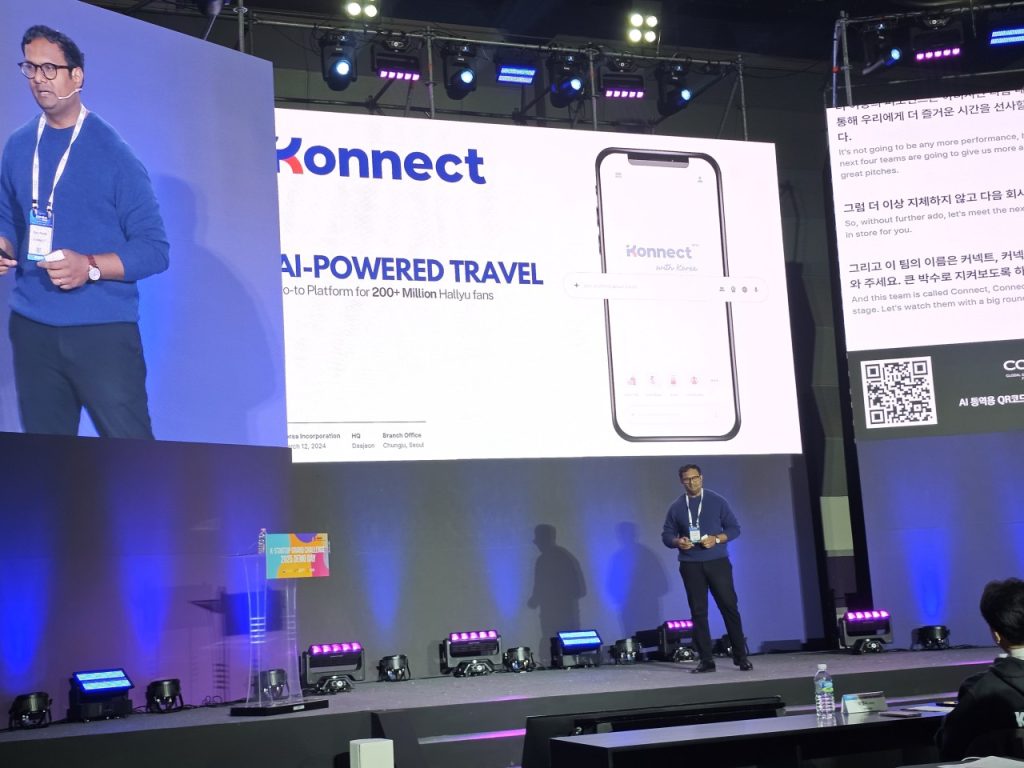
That’s what Konnect is about. It’s a search engine that will transform into a super app. Foreigners from all over the world who visit Korea can easily access services and move freely. They should be able to feel at home when they are in Korea.
Why “Konnect” Is About Integration, Not Reinvention
Is there a story behind the name “Konnect”?
Ravi: The idea behind the name was very clear. Korea has a lot of great companies, but I always felt that companies don’t really work together to create better systems—especially when it comes to serving foreigners.
Let me give you an example. In India, if I use Google Maps, I can book a taxi directly within the app—Uber or Ola. That means those companies have collaborated. In Korea, map systems and taxi systems are not linked. Maybe that’s by design, but I’m not sure.
“We chose the name Konnect because our model is not to create new systems. We want to integrate existing systems, bring them into one platform, and make it user-friendly—with a great foreign user experience and interface—so people can roam around Korea without much worry.”
Ravi Pandit, Founder Konnect
“KR” stands for Korea, so that’s why we have Konnect.kr. It’s about connecting Korea—connecting foreigners with Korea, Koreans with foreigners, Korean businesses together, and foreign and Korean businesses together. We’re not trying to create something never seen before; we want to make existing systems more accessible from a foreigner’s lens.
Designed for Tourists, Students, and Long-Term Residents
Who is Konnect built for – tourists, expats, or both?
Ravi: Our target market starts with people who come to Korea for one to two weeks—typically tourists. As the product becomes more well-known, we’ll move into short-term stays, which could be anywhere from three months to a couple of years. Eventually, our final target is long-term foreign residents.
Each group has very different needs. When you first arrive, you need immediate information. When you’re staying for a few months, your routines become more fixed. And when you’re a resident, you’re looking at daily living—ordering groceries, food delivery, and services. You’re not using taxis every day anymore.
We’re also a startup, so we can’t offer everything from day one.
“We want to build something robust enough to serve these different groups properly.”
Ravi Pandit, Founder Konnect
From Public Policy Student to Startup Founder
Did you move to Korea with a plan to start a company?
Ravi: No, not at all. I came to Korea about four years ago to do my master’s degree in Public Policy at the KDI School of Public Policy and Management.
To be very honest, I never dreamed of starting a company in Korea. It started because of a combination of past experiences and some very sour experiences I had here. I’ve always been a foreigner everywhere I’ve lived—even in my own country. That feeling stays with you.
“My goal was never to start a company—it was simply to see what could be done about the problems I experienced.”
Ravi Pandit, Founder Konnect
Over time, as I got more involved in the startup ecosystem in Korea, we eventually incorporated Konnect.
Building Konnect as a Foreigner in Korea
What does it mean to build a company as a foreigner for foreigners in Korea’s startup ecosystem?
Ravi: In terms of the product, it feels impactful because what we build can really affect millions of people coming to Korea. And our product won’t be limited to Korea—we’ll expand to other countries. Most countries don’t have solutions tailored for foreigners; they only offer certain services, usually in favor of the business itself—book a hotel, book a flight, book an attraction.
Building something that impacts people’s lives feels good, but it’s also difficult to build a company in a foreign country—especially where English isn’t the primary language. It’s hard when you’re speaking with companies and investors, you don’t speak their language, and you don’t look like them. You start to see a distinction between natives and foreigners. It’s fulfilling, but on the business side, it’s tough.
How would you compare Korea’s startup ecosystem to other places you’ve been?
Ravi: Korea is the only place I’ve built a company, so anything else would be hearsay. But there are definitely challenges to starting a business here—regulatory hassles and language. You enter knowing there will be language challenges, so either you speak Korean or you find someone who does.
If you’re bootstrapping or using foreign funds, it can be a better option. But if you want to raise funds from the government or investors, it’s a tough market for foreigners—at least in my opinion.
That said, Korea is making progress. Before, there was basically one program for foreign founders—the K-Startup Grand Challenge. Now there are other programs, often run in English, which help and motivate founders to come. Entrepreneurs need more support when entering a new market than when starting in their own country. There’s still more that can be done at the policy level; it depends on when changes happen.
Beyond Tourism: Working With Cities and Policymakers
Are you planning to work with local businesses or government agencies to improve accessibility for foreigners?
Ravi: Yes. Especially government agencies and city governments that want to attract more tourists to their regions. We’re already in talks with certain city governments to create a seamless tourism experience for foreigners.
We also hope our work can become a platform that helps shape policy decisions. Surveys conducted by governments sometimes miss certain facts.
“As a company focused on the tourism experience, we can see firsthand what problems people face. We can communicate challenges clearly—what we can solve, and what requires policy interventions.”
Ravi Pandit, Founder Konnect
For example, to find a part-time job in Korea, you need certain visas. There may be barriers for students who want to work. Maybe there are policy clauses that make it unfavorable. If we understand the reasons, there may be enhancements the government can make. Even if the government is aware, this could help accelerate policy changes.
One Sentence That Defines the Mission
For someone who’s never heard of Konnect — how would you describe what it does in one sentence?
“The only app you need in Korea.”
Ravi Pandit, Founder Konnect
What Konnect Offers Today—and What’s Coming Next
Can you walk us through what a new user can do on the app or website right now? And what is going to be the onboarding process for new visitors?
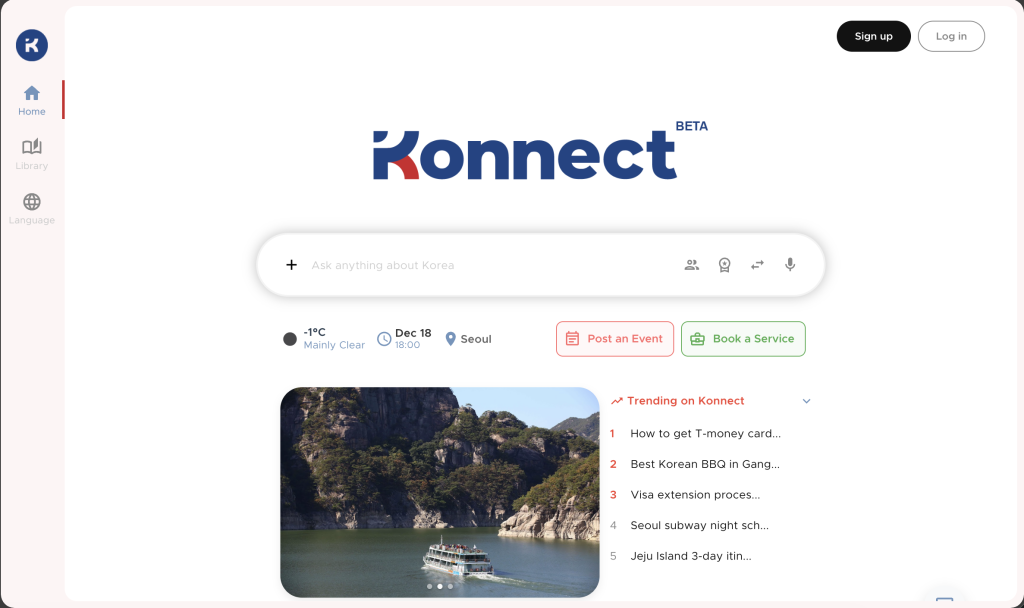
Ravi: There are two aspects. First is the search engine—think of us like Google, or in Korea like Naver.
“We focus on providing reliable, accurate information—not just hearsay.”
Ravi Pandit, Founder Konnect
Right now, this is available on our web platform at Konnect.kr. Eventually, it will become a mobile app.
Second is a service-based model, where people can digitally book multiple services in Korea. Our goal is to start with mobility—buses, taxis, subways. There are technical challenges, but we’re building a solution where, with just a passport, someone can roam around Korea. We hope to launch in the next few months, once development is complete.
Our service is free to use, so people can explore and benefit from it without any hesitation.
We haven’t marketed much yet because we’re still developing. But we already have almost 100,000 visitors. Once people see the convenience, word of mouth can drive growth. We’ll also run marketing campaigns next year.
Building Community Without the Usual Friction
There’s a community element to Konnect. What kind of conversations or stories do you hope to see within the Konnect community?
Ravi: We wanted to remove the friction of having to find the right community before asking a question.
“Sometimes you want advice from someone who understands your context—that makes a big difference.”
Ravi Pandit, Founder Konnect
First, you can ask a question on Konnect, and our AI will map your question and send it to foreigners who are more likely to answer—people who may have the right experience.
Second, we’ll have groups, where people can form communities and talk, similar to other community platforms.
The Hardest Lessons So Far
What’s been the toughest challenge building Konnect so far?
Ravi: There are two major challenges.
First, finding a good team. For tech products, success doesn’t lie with a non-technical CEO like me. I studied engineering, but my current background is non-technical. You need someone with strong technical skills—search infrastructure, scaling systems, building a super app—someone like a jack of all trades. That took longer than expected. Now we have the right CTO—he’s a college friend—and we work well together.
Second, navigating the investor ecosystem in Korea. Our product doesn’t necessarily fit the typical investor scope here. Some parts take time to build. The consensus often feels like: your idea is good—when will you make money?
The second challenge is navigating the investor ecosystem in Korea. Many investors want to know how quickly you’ll make money. We’re still navigating this.
You only need one investor in the end, but finding that person has been challenging. We’ve found some good people interested, but the journey has been tough.
Why Korea Needs to Go Beyond Seoul or Busan
Ravi: For most people, the experience is good—especially if you’re in touristy areas. If you’ve researched well and have your itinerary, it can be a good experience.
Overall, people will likely have a good experience and want to come again. The question is: is Korea only Seoul? Seoul gets maybe 80–85% of first-time tourist landings. It’s vibrant, and I recommend it for a first visit. But after that, people might want to go somewhere else.
Other parts of Korea are just as beautiful, but people don’t have enough information to know whether they’re accessible. Tourists spend money on flights, hotels, food, travel—they can’t take big risks. If they don’t know what to expect, they won’t go.
To get repeat visitors, we need to open up other regions. That requires hyper-localization—almost spoon-feeding directions and information so people feel safe. Building such a structure is challenging, which is why companies refrain from undertaking it. But if you unlock that, you’ll be successful, because people will relate.
Redefining Success for Konnect
Where do you see Konnect in the next few years?
“The founder’s answer is always: we’ll be a unicorn. But I truly see Konnect bridging policy gaps—opening up a country and making it more welcoming for foreigners.”
Ravi Pandit, Founder Konnect
Ravi: If we can help foreigners have safe, meaningful tourist experiences beyond the typical tourist zones, that’s real success. Konnect will be the go-to app for Korea. I believe it because I’ve seen the challenges, and existing solutions don’t provide comfort—they’re too focused on making money. We need money to survive, but our solution comes from the heart. We really want to make the place better.
A Major Milestone: Winning the K-Startup Grand Challenge
Konnect’s journey recently reached a significant milestone when the startup was awarded the grand prize winner of the K-Startup Grand Challenge Demo Day, one of South Korea’s flagship programs for global founders. Competing against thousands of startups from around the world, Konnect emerged as a top winner—an achievement that underscores both the relevance of its mission and the growing recognition of foreign-led innovation in Korea.
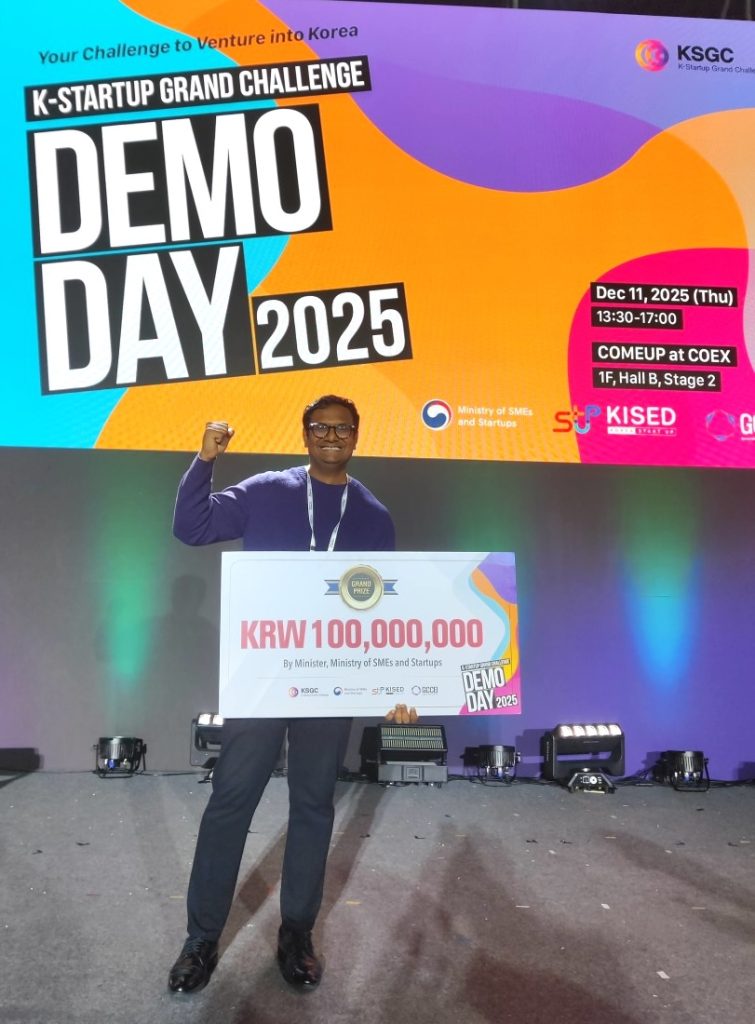
For a platform built to address the everyday challenges faced by foreigners, the recognition carries particular weight. It signals not only validation from Korea’s startup ecosystem but also growing institutional support for solutions that improve accessibility, mobility, and daily life for international visitors and residents.
The win also comes at a pivotal time for Konnect, as the team continues developing its platform beyond information discovery toward integrated services. With increased visibility and support, Konnect is positioned to accelerate its efforts to make Korea easier to navigate—not just for tourists, but for anyone experiencing the country from the outside.
“This win is not the end. It’s the beginning of a much bigger mission.”
Ravi Pandit, Founder Konnect
Quick Takes
One piece of advice to first-time visitors to South Korea: Enjoy it. There are a lot of beautiful things to see. In Seoul, it’s all night long—so drink a lot of Red Bulls and enjoy it from morning to morning.
Favorite Korean food: Galbi (Korean BBQ)
One Korean word every newcomer should know: Annyeonghaseyo (Hello)
About Konnect
Konnect is a Korea-based platform built to simplify life for foreigners through reliable information, integrated services, and community-driven support. Currently available as a web platform at Konnect.kr, the service aims to evolve into a full-scale super app for travelers, students, and expats in South Korea.
Website: https://konnect.kr/
Connect with Ravi: https://kr.linkedin.com/in/ravipandit6
507 total views, 2 views today