
Dive into South Korea’s ₩6.5 billion “Half-Price Rural Travel” pilot utilizing fiscal incentives to combat Seoul concentration and revitalize 16 rural regions.
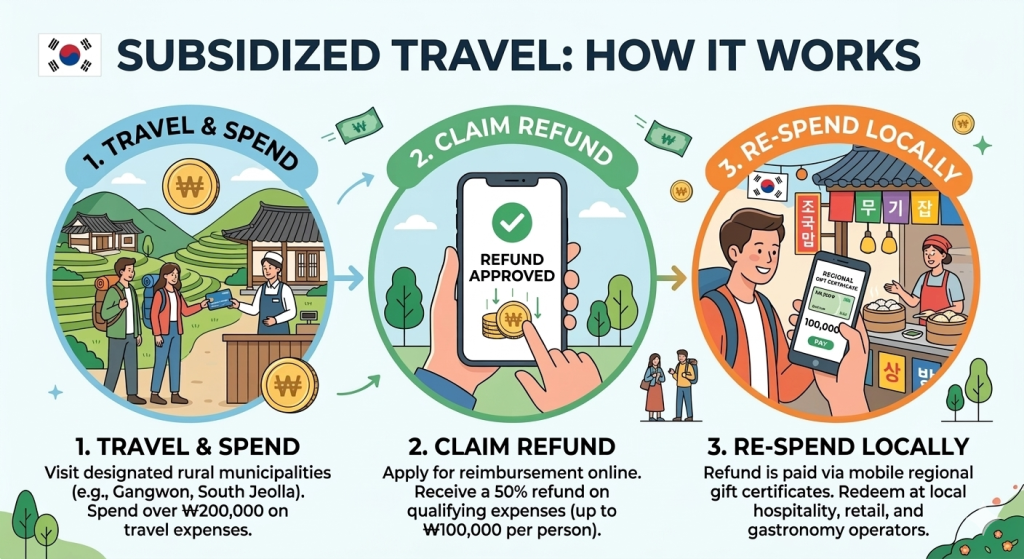
The Ministry of Culture, Sports and Tourism (MCST), in strategic coordination with the Korea Tourism Organization, is launching the Regional Love Vacation Support pilot program in April 2026. This initiative allocates a targeted ₩6.5 billion budget to subsidize 50% of travel expenditures for individuals visiting 16 designated rural municipalities. Notably, the government capped individual reimbursements at ₩100,000, while groups of two or more may claim up to ₩200,000. These refunds are distributed exclusively via mobile regional gift certificates, ensuring that the fiscal stimulus remains locked within local ecosystems.
Official List of the 16 Pilot Municipalities
| Province | Participating Municipalities |
| Gangwon | Pyeongchang-gun, Yeongwol-gun, Hoengseong-gun |
| North Chungcheong | Jecheon-si |
| North Jeolla | Gochang-gun |
| South Jeolla | Gangjin-gun, Yeonggwang-gun, Haenam-gun, Goheung-gun, Wando-gun, Yeongam-gun |
| North Gyeongsang | Yeongyang-gun |
| South Gyeongsang | Miryang-si, Hadong-gun, Hapcheon-gun, Geochang-gun, Namhae-gun |
The Macroeconomic Imperative: Combating the Seoul Concentration Trap
While Seoul continues to dominate as a global cultural magnet, the South Korean hinterland faces a recursive cycle of depopulation and economic atrophy. Crucially, this pilot program serves as a direct intervention to break the “Seoul-Centricity” that currently bottlenecks the nation’s tourism potential. The structural imbalance between the capital’s infrastructure and the rural sectors creates a significant risk for the long-term sustainability of the tourism industry.
Consequently, the government has prioritized 16 localities across provinces such as Gangwon and South Jeolla, specifically targeting areas classified as “extinction-risk” zones. While the government tracks 89 depopulated zones, only these 16 will be in the initial first-half pilot starting in April 2026. Four additional regions are expected to be added in the second half of the year.
The Half-Price Rural Travel pilot in Korea is not merely a promotional endeavor. Rather, it is a calculated attempt to redistribute liquidity from the overheated urban centers to the underserved regional hubs. By providing a tangible financial incentive, the MCST aims to lower the barrier to entry for domestic travelers who would otherwise default to the convenience of the Seoul metropolitan area.
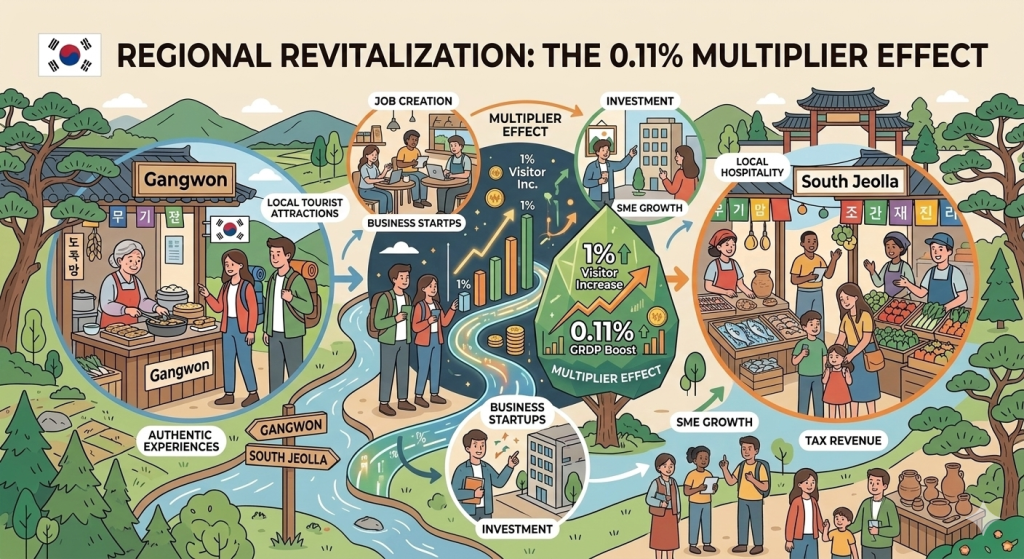
Notably, research indicates that a mere 1% increase in local tourist arrivals translates to a 0.11% rise in Gross Regional Domestic Product (GRDP). While this figure may seem modest in isolation, its cumulative impact on localized service sector employment and business formation is substantial. Therefore, the ₩6.5 billion allocation represents a high-leverage investment designed to trigger a broader economic multiplier effect across the participating prefectures.
Structural Circularity: The Role of Regional Gift Certificates
A pivotal component of this strategy lies in the delivery mechanism of the subsidies. Instead of direct cash transfers, the government utilizes mobile regional gift certificates that must be redeemed within the year at local businesses. This creates a mandatory re-consumption loop that prevents capital flight from the rural regions. Specifically, it forces tourists to engage with local hospitality, retail, and gastronomy operators, thereby stabilizing the revenue streams of small and medium-sized enterprises (SMEs).
Fundamentally, this structural circularity ensures that the initial ₩6.5 billion outlay generates multiple waves of economic activity. As travelers seek to maximize their ₩100,000 refund, they inevitably spend additional capital on regional specialties and luxury experiences that fall outside the subsidy’s coverage. This “top-up” spending behavior is precisely what regional governments require to fund the maintenance of cultural assets and infrastructure.
Crucially, the program also integrates with the Digital Tourism Resident Card system. This synergy encourages visitors to view their rural excursions not as one-off trips, but as ongoing relationships with a second “home” region. By fostering this sense of connection, the government hopes to transition from transient tourism to a model of recurring engagement. Such a shift is essential for regions like Namhae and Hoengseong, where consistent demand is the only viable defense against demographic decline.
Strategic Outlook: From Pilot to Nationwide Infrastructure
Looking ahead to the 2027 fiscal year, the success of this Half-Price Rural Korea Travel pilot phase will dictate the framework for a national rollout. If the 16 localities demonstrate a verifiable surge in per-capita spending and local tax revenue, we expect the MCST to expand the qualifying list to include all 89 designated depopulated zones. This would represent a fundamental shift in how South Korea manages its tourism inventory, moving from a volume-based model to a value-added regional strategy.
Subsequently, investors in the hospitality and prop-tech sectors should monitor these regional movements closely. The government’s commitment to “Regional Revitalization” creates a subsidized floor for demand, reducing the volatility associated with investing in secondary markets. While the initial budget found in this pilot is relatively small at ₩6.5 billion, the policy signal it sends is clear: the state is prepared to underwrite the cost of de-concentrating the tourism economy.
Ultimately, the goal is to transform “K-Life Tourism” from a buzzword into a sustainable economic reality. By 2027, the “Half-Price” model could evolve into a permanent fixture of the Korean social safety net, similar to energy subsidies or childcare credits. For global operators, the message is one of a necessary pivot. Success in the 2026-2027 market will belong to those who can bridge the gap between urban sophistication and rural authenticity, leveraging government-backed liquidity to build the next generation of regional travel experiences.
Related Posts
407 total views, 1 views today