

Last Updated on 4 months by admin
Bilateral tourism ties between South Korea and Nepal are entering a more structured phase, as industry associations from both countries move to formalize cooperation. But beyond the signing ceremony, what does this agreement actually mean for Korean travelers—and for Korea’s broader tourism strategy?
Introduction: A Quiet but Strategic Tourism Move
In mid-December 2025, the Trekking Agencies’ Association of Nepal (TAAN) and the Korea Association of Travel Agents (KATA) signed a Memorandum of Understanding (MoU) to strengthen bilateral tourism cooperation between Nepal and South Korea. The agreement, witnessed by Korean Ambassador to Nepal Park Tae-Young, signals growing institutional interest in deepening travel exchanges between the two countries.
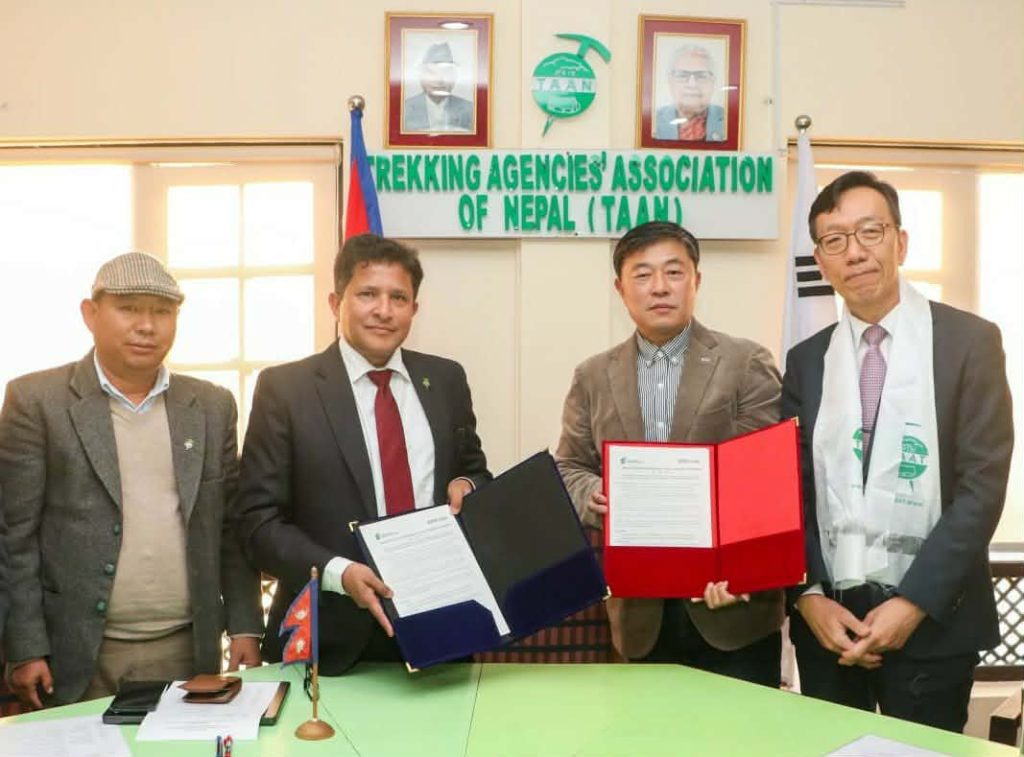
While the announcement did not generate major headlines in Korea, the MoU is noteworthy for what it represents: a shift from ad-hoc travel flows toward organized, safety-focused, and reciprocal tourism development—particularly relevant as Korea’s outbound travel market continues to diversify beyond traditional destinations.
Why This Agreement Has Largely Gone Unnoticed in South Korea
Despite its strategic implications, the TAAN–KATA MoU has attracted little attention in South Korean mainstream media. One reason is scale: Nepal remains a niche outbound destination for Korean travelers compared to Japan, Southeast Asia, or Europe, making bilateral tourism agreements with Nepal less immediately newsworthy in a market driven by volume metrics. In addition, the agreement is industry-led rather than government-announced, signed between tourism associations rather than ministries, which typically results in lower domestic media pickup. These quieter agreements often play a longer-term role in shaping how Korean travelers explore emerging or experience-driven destinations.
What the TAAN–KATA MoU Covers
According to official statements, the agreement focuses on three core areas:
1. Joint Tourism Promotion
TAAN and KATA will collaborate on marketing and promotional programs aimed at encouraging Korean travelers to explore Nepal, particularly its trekking, adventure, and cultural tourism offerings.
This includes coordinated campaigns, information exchange, and potential tour-product development tailored to Korean travel preferences.
2. Safety, Training, and Information Sharing
A major pillar of the MoU is tourist safety. The two associations plan to cooperate on:
- safety training programs,
- improved information dissemination for Korean visitors,
- and coordination on search-and-rescue protocols in trekking regions.
For an adventure destination like Nepal, safety assurance is not a secondary concern—it is a decisive factor in destination choice.
3. Encouraging Two-Way Travel
Importantly, the agreement is reciprocal. It also encourages Nepali travelers to visit South Korea, supporting two-way tourism growth rather than a one-directional outbound flow.
Why This Matters for Korean Travelers
Korea’s Outbound Market Is Maturing
South Korea’s outbound travel market has rebounded strongly in recent years, with travelers increasingly seeking experience-driven, long-haul, and purpose-based trips rather than purely shopping-focused travel.
Nepal fits this evolving demand profile:
- multi-day itineraries,
- nature and adventure experiences,
- cultural immersion rather than urban sightseeing.
The TAAN–KATA MoU lowers structural barriers—particularly around information trust and safety perception—that often limit Korean participation in adventure tourism.
Safety as Strategy, Not Just Risk Management
One of the most meaningful aspects of the MoU is its emphasis on structured safety cooperation.
For Korean travelers—who are often highly risk-aware—formal coordination between travel associations:
- increases confidence in booking,
- reduces reliance on informal or unverified operators,
- and supports repeat visitation.
From a tourism-policy perspective, this reflects a broader global trend: safety infrastructure has become a competitive advantage, not just a regulatory requirement.
Beyond Tourism: Soft Power and People-to-People Ties
The presence of the Korean Ambassador at the signing underscores that this MoU is also about soft diplomacy. Tourism agreements increasingly function as:
- cultural exchange platforms,
- economic connectors for SMEs,
- and long-term relationship builders.
For Korea, which actively promotes cultural exports and global engagement, outbound tourism partnerships reinforce its image as a globally connected society—not just a destination market.
A Small Agreement with Long-Term Implications
The TAAN–KATA MoU may not immediately change travel statistics, but it establishes institutional plumbing—the behind-the-scenes systems that make sustained tourism growth possible.
For Korean travelers, it promises:
- clearer information,
- better safety coordination,
- and more reliable access to Nepal’s adventure offerings.
For Korea’s travel industry, it signals a future where outbound tourism is treated not just as consumer demand, but as a strategic, managed exchange with global partners.
As Korea’s travelers continue to look beyond conventional destinations, agreements like this may quietly shape where—and how—they travel next.
Related Posts
638 total views, 1 views today