
Last Updated on 14 hours by admin
Walk into a local cafe in Busan or a night market in Gwangju today, and you’ll notice something different. The crowd is younger, more diverse, and they aren’t carrying guidebooks. They are living there.
In February 2026, South Korea quietly crossed a monumental threshold. Data from the Korea Immigration Service confirmed that the number of international students hit 314,397, officially surpassing the government’s “Study Korea 300K” goal nearly two years ahead of schedule. While we usually talk about education in terms of classrooms, these students have quietly become the most stable “infrastructure” in the country’s tourism industry.
The “Resident-Tourist”
While this is a win for the Ministry of Education, the real story is being written in the tourism sector. These 314,000 individuals are not just students; they are “Resident-Tourists”—a permanent, high-spending engine that is revitalizing regional economies and bringing the world to corners of Korea that traditional tour buses often miss.
A typical tourist visits for a week and leaves. A student stays for four years. This creates a permanent, reliable baseline for local businesses. In 2026, new rules allow these students to work up to 35 hours a week. This means they have the disposable income to explore their host country, funding regional hotels and domestic trains year-round.
From 7-Day Tourist to 4-Year Resident
The traditional tourism model relies on short-term visitors who stay for an average of 7.2 days. In contrast, an international student is a “Permanent Anchor.” A student isn’t a 7-day visitor; they are a 4-year revenue stream. According to Prabakaran Srinivasan, Founder of Studyinkorea.in and a 15-year veteran in the field, this long-term stay is often preceded by a “trial run.”
“Students want to explore Korea firsthand in the short term before making their final decision. This has led them to opt for short courses, which act as a good start to explore the safety and infrastructure confidently.”
Prabakaran Srinivasan, Founder of Studyinkorea.in
Once enrolled, these students become permanent fixtures in the local economy. In 2026, new labor policies allow Master’s and PhD students to work up to 35 hours per week during semesters, with unlimited hours on weekends. This increased disposable income is being funneled directly into Korea’s leisure economy—from Hocance (hotel vacations) in Busan to cafe-hopping in Gwangju.
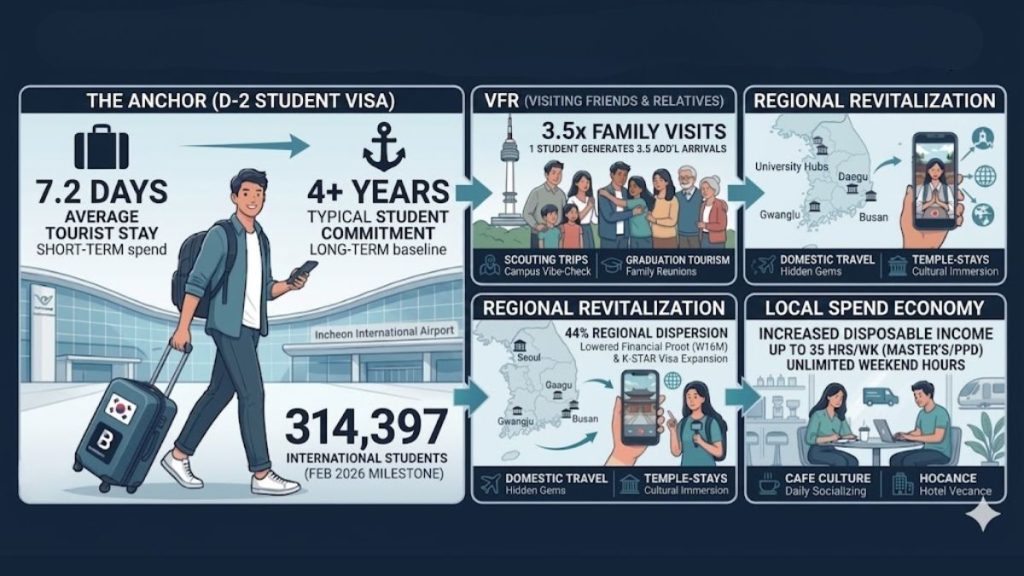
Every student is an anchor for their family back home. This “Visiting Friends and Relatives” (VFR) effect is massive. Parents don’t just fly in for graduation; they visit for “scouting trips” to check on safety and lifestyle. These families stay in local hotels and eat at neighborhood restaurants, bringing tourism dollars to cities that traditional tour buses often skip.
Cracking the “Seoul-Only” Barrier
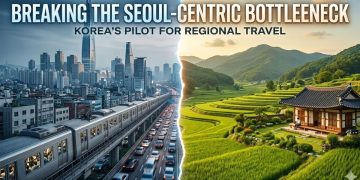
For years, tourism was stuck in Seoul. Now, government programs like the K-STAR Visa are encouraging students to study in regional hubs. As of early 2026, while 56% of international students still reside in the Seoul Metropolitan Area, the tide is turning. The GKS (Global Korea Scholarship) 2026 University Track and the expansion of the K-STAR Visa (now covering 32 universities nationwide) are aggressively pushing talent into regional hubs. These students act as authentic, 24/7 influencers. Their social media posts show the world “hidden gems” in places like Daegu or Jeonju, doing marketing work that no government ad could ever replicate.
- Financial Incentives: Students applying to universities outside Seoul now face a lower financial proof threshold of ₩16 million (approx. $11,800), compared to ₩20 million for metropolitan schools.
- The “Resident-Influencer”: A student in Jeollanam-do or Gangwon-do vlogging their daily life is more effective than any government ad. They showcase the “Instagrammability” of regional Korea to a global audience 24/7.
When a student is based in a regional city, their family’s tourism spend—on hotels, dining, and local transport—directly benefits areas traditionally overshadowed by the capital.
Beyond the “Gram”: Safety and ROI as the New Luxury
While the “Instagrammability” of campuses like Kyung Hee or Yonsei initially captures the imagination, the conversion to residency is driven by hard metrics. In 2026, the volatility of traditional Western universities has made Korea’s safety and policy its most attractive travel feature.
For Indian parents, the luxury of a Korean education isn’t found in a prestige name alone, but in the peace of mind that comes with a high-trust society. This has opened doors beyond STEM; there is a burgeoning interest in business and hospitality. These are the sectors where Korea’s unique service standards offer a competitive edge for global careers.
The economic ripple effect is staggering. Research from the Korea Chamber of Commerce and Industry (KCCI) suggests that for every 1% increase in the share of foreign university graduates in the economically active population, per capita gross regional domestic product (GRDP) increases by about 0.11%.
Furthermore, with the K-Culture (Hallyu) Visa now active, the bridge between being a fan and a resident travel ambassador has never been shorter. While Srinivasan notes that the visa is still in its infancy, he remains bullish: “If the Korean Government takes more initiatives in giving right recognition and awareness… then Korea is unstoppable.”
A 4-Year Tourism Contract
In a time when many regional cities are worried about shrinking populations, these 314,000 students are a demographic rescue mission. They fill the cafes, use the subways, and keep the local culture vibrant.
South Korea isn’t just selling degrees anymore; it’s building a new kind of tourism—one that is built on living together, not just visiting.
In 2026, the message is clear: Come for the K-Pop, stay for the ROI, and build a life in the world’s safest classroom.
Related Posts
34 total views, 34 views today